Natural Justice in Competition Proceedings: NCLAT Sets Aside CCI Order in Grasim Industries Abuse of Dominance Case
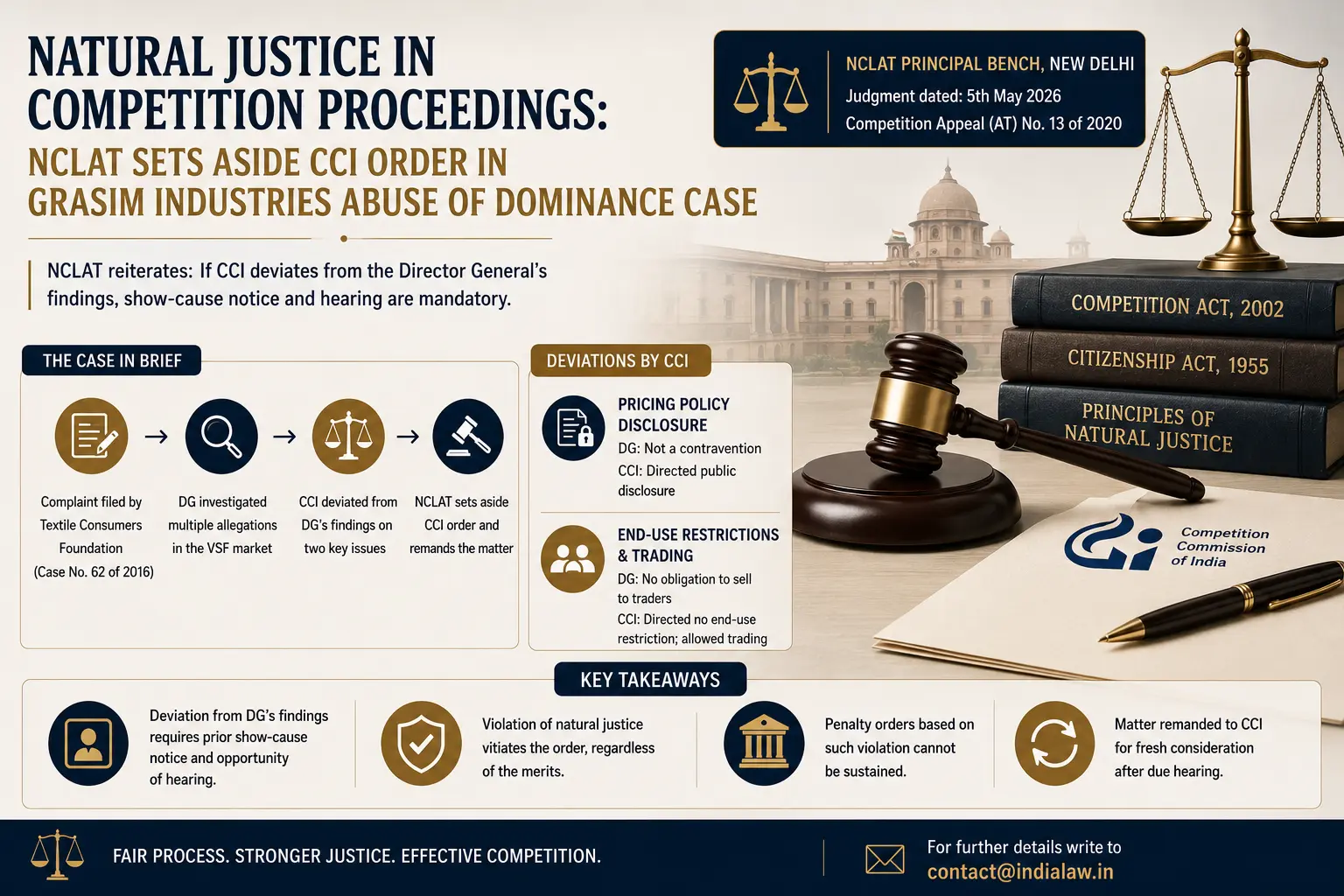
The National Company Law Appellate Tribunal has reinforced the mandatory nature of natural justice compliance where the Competition Commission of India elects to deviate from the findings recorded by the Director General. In Grasim Industries Ltd v. Competition Commission of India and Others, decided on the 5th day of May 2026, the Appellate Tribunal set aside a CCI order that had imposed a penalty of Rs. 301.61 crores upon Grasim Industries Ltd for alleged abuse of dominant position in the market for supply of Viscose Staple Fibre to spinners in India.
The judgment, delivered by Justice Yogesh Khanna, Member (Judicial), and Mr. Ajai Das Mehrotra, Member (Technical), arose from Competition Appeal (AT) No. 13 of 2020 and I.A. No. 1121 of 2021. It represents a critical reaffirmation of the principles of audi alteram partem in the quasi-judicial functioning of the competition regulator.
Background of the Dispute
The genesis of this dispute may be traced to a complaint filed by Textile Consumers Foundation before the Competition Commission of India in Case No. 62 of 2016. Allegations were levelled against Grasim Industries Ltd, the largest producer and seller of Viscose Staple Fibre in the Indian market, of having abused its dominant position in contravention of the provisions of the Competition Act, 2002.
Viscose Staple Fibre, commonly known as VSF, is a man-made fibre extensively used by spinners in the production of yarn. Grasim Industries Ltd, with its registered office at Birlagram, Nagda, District Ujjain in Madhya Pradesh, commands a pre-eminent position in the supply of this commodity within the territory of India.
Upon formation of a prima facie opinion under Section 26(1) of the Competition Act, the Commission directed the Director General to cause an investigation into the allegations, thereby initiating a detailed examination of Grasim’s commercial practices in the relevant market.
Director General’s Investigation and Findings
The Director General, after conducting a comprehensive investigation, submitted a detailed report that examined multiple allegations against Grasim Industries and recorded findings on each of the issues framed for determination. The report, which runs into several volumes, addressed allegations pertaining to unfair and discriminatory pricing, imposition of supplementary obligations upon buyers, refusal to sell to traders, and non-disclosure of pricing and discounting policies.
Findings Adverse to Grasim
On the question of unfair and discriminatory pricing, the Director General found that Grasim had indeed engaged in practices that violated Section 4(2)(a)(ii) read with Section 4(1) of the Competition Act. Specifically, the investigation revealed that:
- The company sold VSF to different customers at different rates.
- Prices were not declared openly but were communicated confidentially to each local customer.
- There existed disparity in the provision of discounts to different customers.
- On numerous occasions, buyers purchasing larger quantities were compelled to pay higher prices than those sourcing lesser quantities.
- Grasim sold VSF at substantially higher rates to domestic customers as compared to deemed exporters and foreign buyers, establishing a pattern of discriminatory conduct.
On the question of supplementary obligations, the Director General found that Grasim required spinners to submit documentary proof of production and export as a condition for claiming discounts on the purchase of VSF. The company also sought monthly production data from its customers before passing on the requisite discounts.
The Director General concluded that these requirements amounted to the imposition of supplementary obligations on the sale of VSF which, by their nature and according to commercial usage, had no connection with the subject of the contract. Such conduct constituted a violation of Section 4(2)(d) read with Section 4(1) of the Competition Act. The Director General’s findings on these two issues were adverse to Grasim and formed the foundation upon which the Commission subsequently built its final order.
Findings Favourable to Grasim
However, the Director General’s report also contained findings that were favourable to Grasim Industries on two distinct issues, and it is these findings that became the focal point of the controversy before the Appellate Tribunal.
On the question of Grasim’s refusal to sell VSF to traders or intermediaries, the Director General explicitly held that the company had no obligation to keep traders in business and could not be faulted for not doing so. Traders were free to import VSF for onward supply to spinners, and the absence of traders in the VSF market was not a creation of Grasim alone. The Director General concluded that this aspect did not appear to fall within the scope of Section 4 of the Competition Act, thereby exonerating Grasim on this specific allegation.
Similarly, on the question of non-disclosure of pricing and discounting policies, the Director General held that not disclosing such policy did not appear in itself to be a contravention of the Act. It was acknowledged that such non-disclosure might lead to unfair and discriminatory pricing, an aspect that had already been covered in the findings on discriminatory pricing. These two findings constituted a clear exoneration of Grasim on the allegations pertaining to traders and pricing policy disclosure.
CCI’s Order and Deviations From the DG Report
The Competition Commission of India, after considering the Director General’s report and the representations filed by the parties, passed its order dated 16th March 2020. The Commission concurred with the Director General’s findings on the two issues of discriminatory pricing and supplementary obligations, but significantly deviated from the Director General’s favourable findings on the issues of pricing policy disclosure and end-use restrictions.
The Commission held that Grasim had abused its dominant position in the relevant market of supply of VSF to spinners in India by charging discriminatory prices to its customers and by imposing supplementary obligations upon them, thereby violating Sections 4(2)(a)(ii) and 4(2)(d) read with Section 4(1) of the Competition Act.
Key Directions Issued by the Commission
The Commission directed Grasim to:
- Cease and desist from discriminatory pricing and supplementary obligation practices.
- Refrain from adopting unfair or discriminatory pricing practices.
- Refrain from seeking consumption details of VSF from buyers.
- Put in place a transparent and non-discriminatory discount policy and make it easily and publicly accessible.
- Not place any end-use restriction on the buyers of VSF so that it would be open to them to use the same for spinning or trading or any other purpose permissible under law.
Nature of the Deviations
The criticality of the Commission’s directions on pricing policy disclosure and end-use restrictions lies in the fact that these directions were fundamentally at variance with the findings recorded by the Director General in Grasim’s favour.
While the Director General had held that non-disclosure of pricing policy was not in itself a contravention of the Act, the Commission directed Grasim to make its discount policy publicly accessible. While the Director General had held that Grasim had no obligation to sell to traders and that refusal to do so was not a violation, the Commission directed that buyers of VSF could use the product for trading purposes, effectively permitting spinners to act as traders in the VSF market.
These deviations formed the core of Grasim’s challenge before the Appellate Tribunal.
Grasim’s Appeal Before NCLAT
Aggrieved by the Commission’s order, Grasim Industries Ltd filed Competition Appeal (AT) No. 13 of 2020 before the National Company Law Appellate Tribunal. The primary grounds of challenge were:
- The Commission had deviated from the Director General’s findings on two issues without affording Grasim an opportunity to show cause or present its case in respect of such deviations, thereby violating the fundamental principles of natural justice embodied in the rule of audi alteram partem.
- The impugned order was a composite, interlinked, and non-severable order with a common penalty of Rs. 301.61 crores calculated on the totality of the findings, and since the penalty could not be segregated among the individual findings, the deviation on any issue vitiated the entire order.
- The violation of natural justice had caused serious prejudice, as the company had been burdened with a substantial financial liability running into hundreds of crores without being afforded an effective opportunity to defend itself against the specific deviations made by the Commission.
Arguments of the CCI and the Informant
CCI’s Defence
The Competition Commission of India defended the impugned order by contending that there was in fact no variation between the Director General’s findings and the Commission’s directions on the material issues.
The Commission argued that the direction regarding end-use restrictions applied only to spinners and not to third-party traders, and that the word “buyer” as used in the impugned order was intended to refer exclusively to spinners of VSF who might trade surplus quantities, rather than to independent traders in the market.
The Commission further contended that since the Director General had found the pricing and discount policy to be discriminatory, the direction to make the policy transparent was merely a consequential measure flowing from the finding of discriminatory pricing, and did not constitute a deviation from the Director General’s report. On the basis of these submissions, the Commission maintained that no show-cause notice was required since there was no material deviation that warranted a separate hearing.
Textile Consumers Foundation’s Submissions
Textile Consumers Foundation, the original informant, adopted a somewhat different line of defence by seeking to distinguish the present case from the precedents relied upon by Grasim.
The Foundation argued that the judgments in BCCI v. CCI and Interglobe Aviation Ltd v. CCI were distinguishable on facts. In those cases the Commission had either changed the definition of the relevant market itself or had completely reversed the Director General’s findings on all the issues framed for determination. In the present case, it was submitted, the Commission had not altered the relevant market definition, which remained the market for supply of VSF to spinners in India as found by both the Director General and the Commission.
The Foundation further relied upon the judgment of the Supreme Court in State of Uttar Pradesh v. Sudhir Kumar Singh to argue that a breach of the principles of natural justice, without the causation of actual prejudice, need not lead to the invalidation of the impugned order. It was contended that no real prejudice could be said to have been caused to Grasim since the substantive violations of discriminatory pricing and supplementary obligations were well established.
NCLAT’s Analysis and Findings
The Appellate Tribunal, after hearing the learned counsel for the parties and perusing the voluminous records, restricted its adjudication to the limited question of whether the Commission had deviated from the Director General’s findings and, if so, whether such deviation required the issuance of a show-cause notice and the grant of an opportunity of hearing to Grasim.
The Tribunal made it abundantly clear at the outset that it was not examining the merits of the case at this stage, and that its adjudication was confined to the procedural issue of compliance with the principles of natural justice. This self-imposed limitation was significant, as it ensured that the Tribunal’s decision would not prejudge the substantive issues that the Commission would be required to determine afresh after remand.
Deviation on Pricing Policy Disclosure
The Tribunal noted that the Director General had clearly held that not disclosing the pricing or discounting policy did not appear in itself to be a contravention of the Act. Yet the Commission had directed Grasim to put in place a transparent discount policy and make it easily and publicly accessible.
The Tribunal found that this direction was contrary to the finding of the Director General, notwithstanding the Commission’s explanation that the direction was merely consequential to the finding of discriminatory pricing. The Tribunal observed that the Director General had explicitly distinguished between the discriminatory nature of the pricing policy and the non-disclosure of such policy, holding the former to be a violation while exonerating the latter. The Commission’s direction on disclosure directly contradicted this specific finding.
Deviation on End-Use Restrictions and Trading
The Tribunal noted that the Director General had held that Grasim had no obligation to keep traders in business and that refusal to sell to traders did not fall within the scope of Section 4 of the Act. Yet the Commission had directed that Grasim shall not place any end-use restriction on the buyers of VSF and that it would be open to them to use the same for spinning or trading or any other purpose permissible under law.
The Tribunal rejected the Commission’s explanation that the word “buyer” in this direction referred only to spinners and not to independent traders. Such an interpretation was not borne out by the plain reading of the direction, which contained no such definitional limitation.
The Tribunal observed that in common parlance, if a buyer is allowed to trade, then such buyer can be assumed to be a trader. The Commission’s direction effectively permitted the emergence of trading activity in VSF by entities that were not spinners, thereby creating a secondary market that the Director General had held Grasim was not obligated to enable.
Reliance on Binding Precedents
Having identified these two deviations, the Tribunal proceeded to examine the legal position governing the Commission’s obligation to afford an opportunity of hearing where it differs from the Director General’s findings. The Tribunal placed heavy reliance upon three key precedents:
- BCCI v. CCI — The Competition Appellate Tribunal had held that if the Commission wishes to differ with the Director General on any issue, it must give notice spelling out its intention to do so and provide an opportunity of hearing to the concerned party. Failure to do so vitiates the finding due to violation of the rule of audi alteram partem. The Commission’s failure to disclose information or material proposed to be used for arriving at a finding, and to give an effective opportunity to the party concerned to controvert the same, results in a violation of the principles of natural justice and occasions a failure of justice.
- Interglobe Aviation Ltd v. CCI — The Competition Appellate Tribunal had held that the Commission must give an action-oriented notice to the parties incorporating the reasons for its disagreement with the Director General’s findings, and that the omission to give such notice deprived the appellants of a valuable opportunity to effectively defend themselves. The Commission had passed the impugned order without giving an action-oriented notice and an effective opportunity to controvert what the Commission had perceived as contrary to the provisions of the Act, amounting to a clear violation of the basics of natural justice which the Commission was duty bound to comply with in view of the mandate of Section 36(1) of the Competition Act. The violation of natural justice in that case had caused serious prejudice because the appellants had been condemned without being afforded an opportunity to present their cause and burdened with huge financial liability running into crores of rupees.
- Balrampur Chini Mills Ltd v. CCI — The Tribunal had held that non-compliance with the principle of natural justice solely due to a faulty and irrational procedure followed by the Competition Commission had certainly meant prejudice to the appellants, as they were imposed penalty on the basis of such a procedure being followed by the Commission.
The application of these three binding precedents established a clear and consistent judicial position that wherever the Commission differs from the findings recorded by the Director General, it is mandatory to issue a show-cause notice incorporating the reasons for such disagreement and to afford the concerned party a reasonable opportunity of being heard.
Rejection of the Respondents’ Arguments
The Tribunal rejected the respondents’ arguments seeking to distinguish the present case from the precedents or to establish that no prejudice had been caused.
The Tribunal held that the Commission’s explanation that the word “buyer” referred only to spinners was not sustainable on a plain reading of the impugned direction. The Commission’s direction on pricing policy disclosure was directly contrary to the Director General’s finding that non-disclosure was not a contravention.
The Tribunal further held that the prejudice to Grasim was manifest, given the composite and non-severable nature of the impugned order and the imposition of a penalty of Rs. 301.61 crores that could not be segregated among the individual findings.
The Tribunal noted that the requirement to issue a show-cause notice before passing an order had now been statutorily codified in the proviso to Section 26(9) of the Competition Act, which was enforced with effect from 19th September 2024. This statutory amendment merely affirmed what had already been established in the decisions of the Competition Appellate Tribunal in BCCI and Interglobe Aviation Ltd.
Outcome and Directions
In the conspectus of the facts and circumstances of the case, the National Company Law Appellate Tribunal allowed the appeal and set aside the impugned order of the Competition Commission of India dated 16th March 2020.
The Tribunal remanded the matter back to the Commission with a specific direction to provide an opportunity to Grasim Industries Ltd wherever the Commission differs with the findings of the Director General, and to decide the case expeditiously in a time-bound manner.
The Tribunal made it explicitly clear that it had not commented on the merits of the case and that the Commission should not be influenced by anything contained in the judgment while deciding the case after due show-cause notice to the Appellant. No order as to costs was made, and pending applications, if any, were also disposed of.
Significance of the Judgment
The decision in Grasim Industries Ltd v. Competition Commission of India stands as a strong affirmation of the mandatory and non-negotiable nature of procedural fairness in competition adjudication. By setting aside the Commission’s order and remanding the matter for compliance with the principles of natural justice, the Appellate Tribunal has sent a clear signal that the integrity of the competition enforcement process cannot be compromised by after-the-fact procedural irregularities, however well-intentioned the substantive findings may be.
The judgment:
- Reinforces the exclusive obligation of the Commission to issue show-cause notices where it proposes to deviate from the Director General’s findings.
- Highlights the binding nature of the Tribunal’s own precedents on this issue.
- Protects the procedural foundations of the competition law framework against the erosion of unprincipled efficiency.
For competition practitioners, the Commission, and parties subject to competition proceedings, this ruling provides definitive guidance that the audi alteram partem rule is not a mere formality but an essential safeguard that ensures fairness, transparency, and predictability in the enforcement of competition law.
The judgment is a sentinel guarding the procedural foundations of competition adjudication against the encroachment of unprincipled expediency. Its alignment with the statutory amendment to Section 26(9) demonstrates the enduring vitality of natural justice principles in the changing environment of Indian competition law.
For further details write to contact@indialaw.in
By entering the email address you agree to our Privacy Policy.