Digital Transformation of OCI Administration: An Analysis of the Citizenship (Amendment) Rules, 2026
Introduction
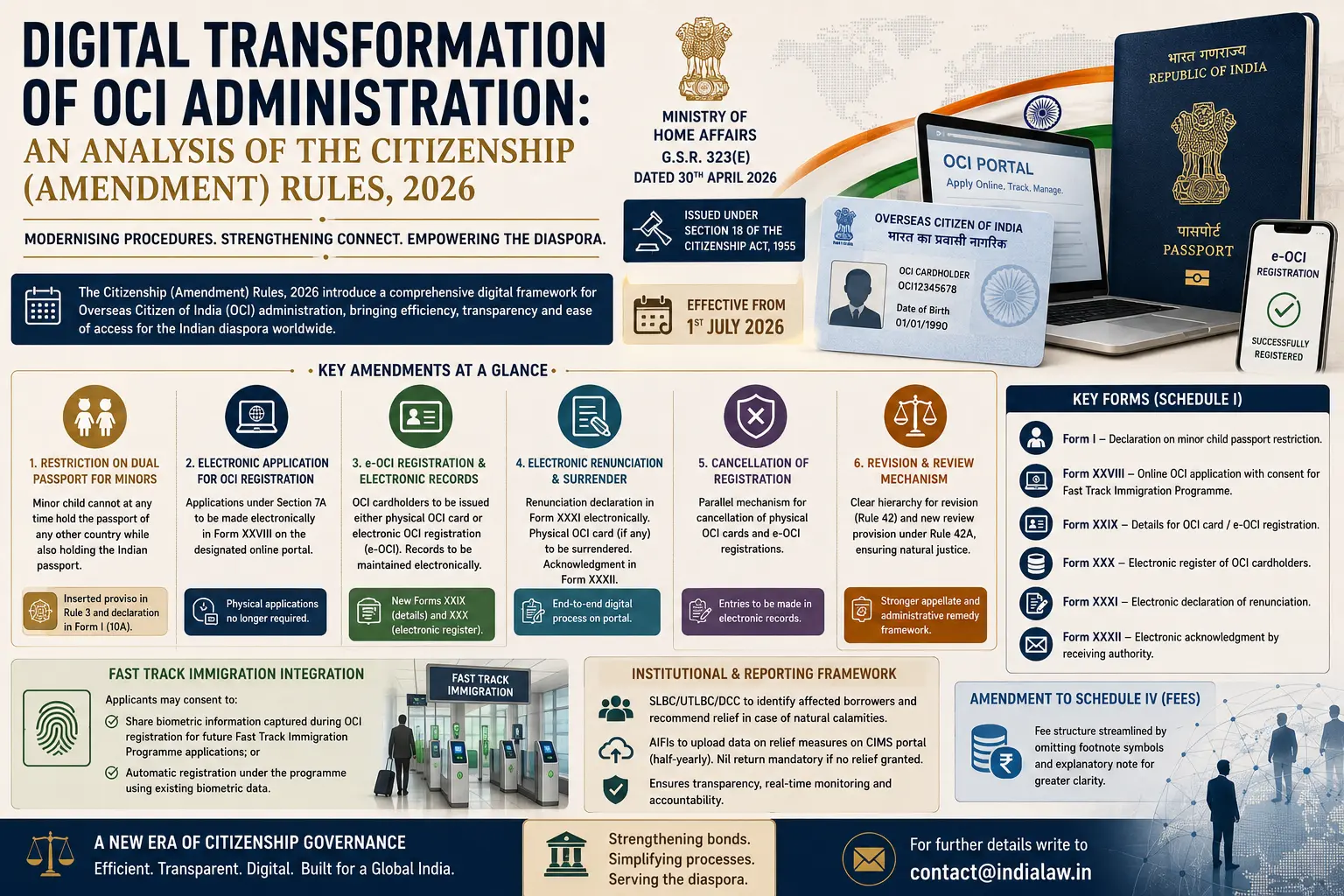
The administration of citizenship and overseas citizen status in India has undergone a paradigmatic shift with the notification of the Citizenship (Amendment) Rules, 2026 by the Ministry of Home Affairs on 30th April 2026. Published in the Gazette of India Extraordinary, Part II—Section 3(i) as G.S.R. 323(E), these rules were issued under Section 18 of the Citizenship Act, 1955, which empowers the Central Government to frame rules for carrying out the purposes of the parent statute.
The principal Citizenship Rules, 2009, originally notified vide G.S.R. 124(E) dated 25th February 2009 and last amended vide G.S.R. 172(E) dated 11th March 2024, have now been substantially overhauled. Key areas of reform include:
- Electronic processes for citizenship applications
- Electronic Overseas Citizen of India (e-OCI) registrations
- Biometric integration with immigration programmes
- Clarified restrictions on dual passport holding for minor children
The present article examines each amendment in its legal and administrative context, elucidating the far-reaching impact of these changes on India’s citizenship governance framework.
Background and Legislative Genesis
The Citizenship Act, 1955 constitutes the foundational statute governing citizenship matters in India, with Section 18 providing the rule-making authority to the Central Government. The 2009 Rules framed thereunder have governed the procedural aspects of citizenship by birth, descent, registration, naturalization, and overseas citizen status for over seventeen years.
The 2026 amendment represents the most comprehensive restructuring of these procedures, driven by the imperatives of digital governance, administrative efficiency, and enhanced service delivery to the Indian diaspora.
The amendments specifically target the Overseas Citizen of India cardholder framework, which was introduced through the Citizenship (Amendment) Act, 2003 and has emerged as a critical mechanism for maintaining constitutional and emotional linkages with persons of Indian origin across the globe.
Short Title and Commencement Provision
The rules are titled the Citizenship (Amendment) Rules, 2026 and have been made effective from the date of their publication in the Official Gazette, ensuring immediate applicability without any deferred implementation timeline.
This immediate commencement reflects the administrative urgency and policy priority attached to the digital transformation of citizenship processes.
Restriction on Dual Passport Holding for Minor Children
A significant substantive amendment has been introduced through the insertion of a proviso in Rule 3, which explicitly provides that the applicant shall note that the minor child cannot at any time hold the passport of any other country while also holding the Indian passport.
This provision reinforces the constitutional prohibition against dual citizenship under Article 9 of the Constitution of India and Section 9 of the Citizenship Act, 1955. By making this restriction explicit at the application stage, the amendment seeks to prevent inadvertent situations where minor children might simultaneously possess Indian and foreign passports.
This ensures clarity of nationality status from the earliest documentation stage. The same declaration has been incorporated in Form I through the insertion of a new serial number 10A in Schedule I, requiring applicants to formally acknowledge this restriction.
Electronic Application for OCI Registration
Rule 29(1) has been substituted to mandate that applications for registration as an Overseas Citizen of India cardholder under Section 7A of the Citizenship Act, 1955 shall be made in Form XXVIII electronically on the designated online portal.
This amendment eliminates physical application submissions and aligns the OCI registration process with the Digital India initiative. The designated portal ensures centralized processing, real-time tracking, and standardized verification protocols, thereby reducing administrative delays and enhancing transparency in the registration process.
Streamlining of Application Procedures
Rule 31 has been amended to remove the requirement of submitting applications in duplicate, reflecting the transition from physical to electronic documentation where duplication is unnecessary.
Additionally, sub-clause (ii) of clause (a) has been omitted, further eliminating redundant procedural requirements and simplifying the application architecture for both applicants and processing authorities.
Introduction of e-OCI Registration and Electronic Record Maintenance
Rule 33 has been comprehensively substituted to introduce a dual-mode issuance framework for OCI cardholders. Every person registered under Section 7A shall now be issued either an Overseas Citizen of India card in physical form or an electronic Overseas Citizen of India (e-OCI) registration containing the details specified in Form XXIX.
This e-OCI registration represents a significant innovation, offering flexibility to applicants while promoting digital adoption and reducing the logistical burden of physical card production and international mailing.
Concurrently, the issuing authority is now required to maintain records of registered persons in Form XXX in electronic form, replacing manual registers with digitized record-keeping systems that enable real-time updates, cross-referencing, and audit trails.
Electronic Renunciation and Surrender Mechanism
Rule 34 has been substituted to digitize the renunciation process for OCI cardholder status. A declaration of renunciation under Section 7C must now be submitted electronically in Form XXXI on the designated portal to the Indian Mission or Post concerned or the Foreigners Regional Registration Officer concerned.
Where the OCI card was issued in physical form, the original card must also be surrendered to the same authorities.
Upon receipt, the concerned authority shall issue an acknowledgment in Form XXXII electronically on the portal and remove the declarant’s name from the electronic record maintained under Rule 33(2). This end-to-end electronic process eliminates the need for physical document transmission, reduces processing timelines, and ensures immediate updating of registry records.
Cancellation of Registration and Parallel Treatment of Physical and Electronic Cards
Rule 35 has been substituted with a comprehensive four-sub-rule framework governing the cancellation of OCI registration. The key provisions are:
- Where an order cancelling registration is made, the affected person or any person in possession of the physical OCI card must deliver the original card when required by written notice from the Central Government within the specified period.
- Upon delivery, the card shall be cancelled; if not delivered, the Central Government may direct that it shall be treated as cancelled.
- For persons issued e-OCI registrations, the Central Government may direct that the e-OCI registration shall be treated as cancelled.
- The issuing authority is required to make an appropriate entry in the electronic record stating the cancellation.
This parallel treatment ensures that both physical and electronic OCI registrations are subject to equivalent cancellation mechanisms, maintaining regulatory parity across modes of issuance.
Revision Authority Hierarchy
Rule 42 has been substituted to establish a clear appellate hierarchy for revision applications under Section 15 of the Citizenship Act, 1955. The framework operates as follows:
- For orders relating to citizenship applications under the Act, revision shall be disposed of by an authority one rank higher than the authority that made the original order.
- For orders relating to OCI registration under Section 7A or cancellation of OCI registration under Section 7D made by an Indian Mission or Post or the Foreigners Regional Registration Officer, revision shall be disposed of by an authority as specified by the Central Government.
- In all cases, the revision application shall be disposed of after giving a reasonable opportunity to the affected person to present their case, ensuring compliance with the principles of natural justice.
Introduction of Review Mechanism
A new Rule 42A has been inserted to provide for review applications under Section 15A of the Citizenship Act, 1955. Such applications shall be disposed of by the Central Government after giving a reasonable opportunity to the affected person to present their case.
This creates a distinct review mechanism separate from revision, ensuring comprehensive administrative remedies and addressing potential gaps in the appellate framework.
Amendments to Schedule I Forms and Fast Track Immigration Integration
Schedule I has undergone substantial amendments to reflect the digital transformation and integrate new policy initiatives.
In Form I, a new declaration regarding minor child passport restrictions has been inserted. In Form XXVIII, redundant fields have been removed from both the Indian Origin Applicant and Spouse Based Applicant sections.
A new paragraph has been inserted in the Declaration section regarding consent for the Fast Track Immigration Programme. This consent mechanism allows applicants to either:
- Authorize the sharing of biometric information captured during OCI registration for future Fast Track Immigration Programme applications, or
- Consent to automatic registration under that programme using existing biometric data.
This integration represents a forward-looking approach to immigration facilitation, using existing biometric capture for enhanced service delivery.
Restructured Forms (XXIX–XXXII)
- Form XXIX has been substituted to specify details for both physical OCI cards and e-OCI registrations, including unique OCI number, category, personal particulars, passport details, and family information.
- Form XXX has been restructured as an electronic register containing comprehensive applicant details, registration history, renunciation and cancellation records, and remarks.
- Form XXXI has been transformed into an electronic declaration for renunciation, containing detailed declarant particulars and solemn affirmation.
- Form XXXII has been adapted as an electronic acknowledgment issued by receiving officers, confirming receipt of renunciation declarations and physical card surrenders where applicable.
Amendments to Schedule IV Fee Structure
Schedule IV has been simpler by omitting certain footnote symbols from the fee table and removing the explanatory note, simplifying the fee structure presentation and reducing potential confusion for applicants regarding fee applicability.
Conclusion
The Citizenship (Amendment) Rules, 2026 constitute a landmark reform in India’s citizenship administration, transitioning from paper-based, manually intensive processes to electronic, portal-driven governance.
By introducing e-OCI registrations, mandating electronic applications and renunciations, integrating biometric data with immigration facilitation programmes, clarifying minor child passport restrictions, and establishing structured revision and review mechanisms, these rules reflect a modernized approach to diaspora engagement. The amendments align with the Digital India vision while maintaining the statutory safeguards and constitutional principles underlying Indian citizenship law.
For the Indian diaspora, these changes promise:
- Enhanced accessibility
- Reduced processing timelines
- Improved service delivery
For administrative authorities, the electronic framework offers:
- Simplified verification
- Real-time record maintenance
- Enhanced regulatory oversight
As India’s engagement with its global diaspora deepens, the Citizenship (Amendment) Rules, 2026 provide the essential procedural infrastructure for efficient, transparent, and responsive citizenship governance in the digital age.
For further details write to contact@indialaw.in
By entering the email address you agree to our Privacy Policy.