Timelines as Sacred: NCLAT Reinforces Mandatory Bar on Late Resolution Applicants in Ram Prasad Agarwala v. Bijay Murmuria
Introduction
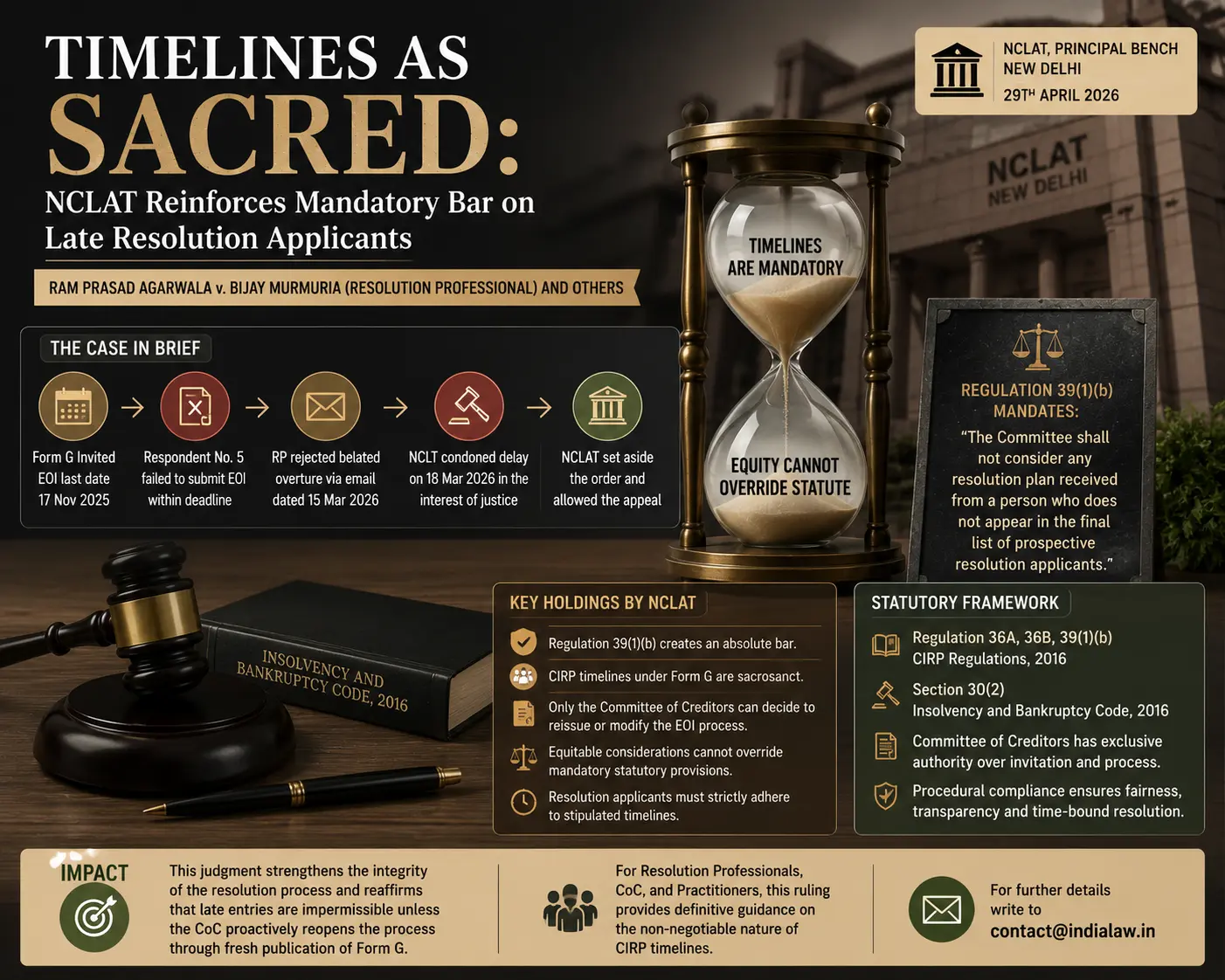
The sanctity of timelines in corporate insolvency proceedings has once again been affirmed by the National Company Law Appellate Tribunal in a ruling that highlights the mandatory nature of procedural compliance under the Insolvency and Bankruptcy Code, 2016. In Ram Prasad Agarwala v. Bijay Murmuria (Resolution Professional) and Others, decided on 29th April 2026, the Appellate Tribunal set aside an order of the National Company Law Tribunal that had condoned delay in submission of Expression of Interest by a prospective resolution applicant.
The judgment was delivered by the Principal Bench at New Delhi, comprising Mr. Justice Ashok Bhushan as Chairperson and Mr. Indevar Pandey as Technical Member. It is reported as (2026) ibclaw.in 591 NCLAT and arose from Comp. App. (AT) (Ins) No. 661 of 2026, involving the Corporate Debtor Fairdeal Supplies Limited.
The impugned order under challenge was passed by the NCLT in Siraj Holding LLC v. Bijay Murmuria RP of Fairdeal Supplies Ltd. and Others, (2026) ibclaw.in 912 NCLT. The appeal was preferred by Ram Prasad Agarwala, a suspended Director of the Corporate Debtor.
Background and Genesis of the Dispute
The Corporate Debtor, Fairdeal Supplies Limited, was undergoing the Corporate Insolvency Resolution Process under the Insolvency and Bankruptcy Code, 2016. In the ordinary course of the CIRP, the Resolution Professional published Form G inviting Expressions of Interest from prospective resolution applicants, specifying the following timelines:
- 17th November 2025 as the last date for submission of EOI
- 19th November 2025 as the date for publication of the provisional list of Prospective Resolution Applicants
- A subsequent date for the final list
The Appellant, being a suspended Director of the Corporate Debtor, had a vested interest in ensuring that the resolution process adhered strictly to statutory timelines and procedural requirements.
Respondent No. 5, Siraj Holding LLC, failed to submit its Expression of Interest within the stipulated deadline and was consequently excluded from both the provisional and final lists of Prospective Resolution Applicants. The Resolution Professional, by his email dated 15th March 2026, rejected the belated overture of Respondent No. 5.
Aggrieved by this rejection, Respondent No. 5 filed I.A. No. 362 of 2026 before the National Company Law Tribunal, seeking the following reliefs:
- Setting aside of the Resolution Professional’s rejection
- Permission to participate in the CIRP as a Prospective Resolution Applicant
- Direction to the Resolution Professional to consider its resolution plan
- Additional time for submission
- Access to Information Memorandum and Virtual Data Room
- Condonation of delay in submitting the EOI
- An interim direction restraining the opening of any resolution plan pending disposal of the application
The NCLT’s Impugned Order
The National Company Law Tribunal, by its order dated 18th March 2026, allowed the application filed by Respondent No. 5. In paragraph 10 of the impugned order, the Adjudicating Authority condoned the delay in submission of the Letter of Intent and the resolution plan, observing that such condonation was warranted in the interest of justice and all stakeholders.
The NCLT directed that timelines should be adhered to by the applicant for subsequent submissions, including the EOI and the Resolution Plan, and that the entire process be completed within a stipulated timeframe. This exercise of equitable jurisdiction by the NCLT, bypassing the mandatory procedural framework of the CIRP Regulations, formed the subject matter of the present appeal.
Statutory Framework and Regulatory Provisions
The resolution of this appeal hinged upon the interpretation and application of specific provisions of the Insolvency and Bankruptcy Board of India (CIRP) Regulations, 2016. The key regulatory provisions at play were:
- Regulation 36A — empowers the Committee of Creditors to invite Expressions of Interest and to modify such invitation
- Regulation 36B — prescribes the time for submission of resolution plans
- Regulation 39(1)(b) — mandates that the Committee shall not consider any resolution plan received from a person who does not appear in the final list of prospective resolution applicants
The provision critical was Regulation 39(1)(b), which employs the imperative “shall not,” creating an absolute and non-negotiable prohibition. Additionally, Regulation 36A, which governs the invitation for Expression of Interest, vests exclusive authority in the Committee of Creditors to modify the invitation and to take decisions regarding the continuation or fresh issuance of the EOI process.
The Appellant also relied upon Section 30(2) of the Insolvency and Bankruptcy Code, 2016, which prescribes the contents and requirements of a resolution plan, and the overarching objectives of the Code including value maximization and time-bound resolution.
Rival Contentions Before the Appellate Tribunal
Appellant’s Contentions
The Appellant contended that the impugned order was unsustainable in law as it directly contravened the mandatory prohibition embodied in Regulation 39(1)(b) of the CIRP Regulations. It was submitted that Respondent No. 5, not having been included in either the provisional or final list of Prospective Resolution Applicants, was statutorily barred from submitting any resolution plan for consideration by the Committee of Creditors.
The Appellant placed strong reliance upon the judgment of this very Tribunal in Comp. App. (AT) (Ins) No. 464 of 2024, Aashdan Properties Private Limited v. Dr. Mamta Binani (Resolution Professional of Rolta India Limited), (2024) ibclaw.in 168 NCLAT, where paragraphs 9, 10 and 11 had authoritatively laid down the following principles:
- The Committee shall not consider a resolution plan from an applicant whose name does not appear in the list of Prospective Resolution Applicants.
- The Regulation creates a clear and mandatory bar.
- It is always open for the Committee of Creditors to take a decision not to proceed with existing applications and to issue fresh Form G, but when no fresh Form G has been issued, it is not open for any new applicant to approach the Adjudicating Authority for permission to participate in the CIRP.
Respondents’ Contentions
The Respondents defended the impugned order on the ground of equity and the interest of justice, arguing that condonation of delay would serve the value maximization object of the Insolvency and Bankruptcy Code and would be in the interest of all stakeholders.
Analysis and Reasoning of the Appellate Tribunal
The National Company Law Appellate Tribunal, after hearing learned counsel for the Appellant and the Respondents, undertook a succinct yet rigorous analysis of the legal position. The Tribunal reaffirmed that Regulation 39(1)(b) creates a mandatory prohibition that cannot be diluted by equitable considerations or the omnibus invocation of the interest of justice.
The word “shall” in the regulation was interpreted as imperative, leaving no room for discretion either with the Committee of Creditors or the Adjudicating Authority to entertain resolution plans from applicants excluded from the final list.
The Tribunal applied its own binding precedent in Aashdan Properties, noting that the principles laid down therein were directly applicable to the facts of the present case. The analysis further emphasized that the power to invite fresh applications or to modify the Expression of Interest process lies exclusively with the Committee of Creditors under Regulation 36A, and this power cannot be usurped by individual applicants approaching the Adjudicating Authority directly.
The Tribunal observed that any Resolution Applicant can be considered only in accordance with the timelines specified in Form G, and that the CIRP framework does not countenance ad hoc relaxation of these timelines. The NCLAT implicitly rejected the NCLT’s reliance on general equitable jurisdiction, holding that such jurisdiction cannot be exercised in a manner that overrides express statutory prohibitions designed to maintain the integrity and time-bound nature of the insolvency resolution process.
Final Decision and Operative Directions
The National Company Law Appellate Tribunal allowed the appeal and set aside the impugned order of the National Company Law Tribunal dated 18th March 2026. The Tribunal issued the following operative directions:
- The order directing acceptance of the late Expression of Interest of Respondent No. 5 could not be sustained in law and was set aside.
- Any Resolution Applicant can be considered only in accordance with the timelines as provided in Form G.
- It is for the Committee of Creditors to take further decision and to proceed in accordance with law.
With these directions, the appeal was disposed of. The judgment thus restores the procedural rigor of the CIRP framework and reinforces the principle that mandatory timelines and eligibility criteria are not mere formalities but essential safeguards that ensure fairness, transparency and predictability in the resolution process.
Conclusion
The decision in Ram Prasad Agarwala v. Bijay Murmuria stands as a strong affirmation of the mandatory and non-negotiable nature of procedural timelines in corporate insolvency resolution. By setting aside the NCLT’s condonation of delay and reiterating the absolute bar under Regulation 39(1)(b) of the CIRP Regulations, the National Company Law Appellate Tribunal has sent a clear signal that the integrity of the resolution process cannot be compromised by after-the-fact equitable relief, however well-intentioned.
The judgment reinforces the exclusive domain of the Committee of Creditors in managing the applicant pool, highlighting the binding nature of the Tribunal’s own precedents, and protects the sanctity of Form G as the gateway to participation in the CIRP.
For resolution professionals, committee of creditors, prospective resolution applicants and practitioners of insolvency law, this ruling provides definitive guidance that late entries into the resolution process are impermissible unless the Committee of Creditors proactively reopens the process through fresh publication of Form G. This judgment is a sentinel guarding the procedural foundations of the Corporate Insolvency Resolution Process against the erosion of ad hocism and the encroachment of unprincipled equity.
For further details write to contact@indialaw.in
By entering the email address you agree to our Privacy Policy.