
Corporate Finance
Corporate Finance Lawyers in India for Term Loans, Lending, and RBI Compliance
Our Corporate Finance practice advises banks, non-banking financial companies, multilateral lenders, corporate borrowers, and promoter entities on structured lending transactions across the credit spectrum. This includes short-tenor working capital facilities, multi-bank consortium term loans, acquisition financings, bridge and refinance facilities, and bilateral and syndicated term arrangements.
Our work covers the full life cycle of a corporate loan. We conduct pre-disbursement legal due diligence on the borrower group and its subsidiaries, and draft and negotiate facility agreements, security packages, hypothecation and pledge documentation, mortgages, negative liens, and the inter-creditor and common loan arrangements that underpin large syndicated deals. We advise lenders on RBI lending norms, sectoral exposure caps, large exposure framework requirements, and the SEBI regime where listed borrowers or listed debt is involved.
We also handle post-disbursement workstreams, including covenant testing and waiver letters, security perfection and registration with the Registrar of Companies and CERSAI, ongoing reporting obligations, and regulatory engagement with the RBI, SEBI, and other authorities. We act for clients through refinancings, additional facility tranches, and restructuring exercises.
Our Services
Expertise in Corporate Loan Documentation
We assist clients (primarily banks, financial institutions, and corporate borrowers) with the structuring, drafting, and negotiation of various forms of term loan agreements, including:
- Short-term and long-term corporate loans
- Working capital facilities
- Acquisition finance
- Bridge loans and refinancing arrangements
Consortium Lending & Multiple Banking Arrangements (MBA)
We have represented clients in consortium loan structures and bilateral lending arrangements, ensuring effective coordination among lenders while protecting client interests through:
- Drafting and reviewing inter-creditor agreements, common loan agreements, and shared security packages
- Structuring common security creation and ensuring proper enforcement mechanisms
- Negotiating with multiple stakeholders to align terms and achieve smooth execution
Legal Due Diligence & Compliance Support
Our legal team regularly conducts legal due diligence on borrower entities to verify compliance with corporate, financial, and regulatory requirements. We help preempt legal and operational risks by:
- Reviewing corporate governance structures and statutory filings
- Advising on sector-specific compliance and lender obligations
- Monitoring covenant compliance and reporting obligations
Security Perfection & Regulatory Filings
We provide end-to-end assistance in the perfection and registration of security interests, including:
- Hypothecation, mortgage, and pledge documentation
- Filing with ROC (Registrar of Companies) and CERSAI (Central Registry of Securitisation Asset Reconstruction and Security Interest)
- Liaising with relevant authorities for regulatory approvals and compliance
Strategic Negotiation Support & Regulatory Advisory
We support our clients through complex financing negotiations involving multiple banks or financial institutions, ensuring alignment with commercial goals while preserving legal protections. We also advise promoter entities on regulatory challenges, compliance hurdles, and interface with government bodies or regulators.
Related Expertise
Key Professionals





FAQs
What does a corporate finance lawyer handle in India?
A corporate finance lawyer advises on structuring, documenting, and negotiating lending transactions such as term loans, working capital facilities, acquisition financing, and consortium arrangements. The role spans due diligence, security creation, regulatory compliance, and post-disbursement support.
When should a borrower or lender engage a corporate finance lawyer?
Engage counsel early, ideally before the term sheet is finalised. Legal input at the structuring stage helps align security packages, inter-creditor terms, and regulatory conditions. Waiting until documentation is drafted often leads to costly renegotiation or compliance gaps.
Which Indian regulators and laws govern corporate lending transactions?
RBI master directions on lending, large exposure framework norms, and FEMA rules for cross-border elements are primary. Security interests must be registered with the ROC under the Companies Act 2013 and with CERSAI. SEBI regulations apply where listed debt or listed borrowers are involved.
How long does it typically take to close a corporate loan transaction?
A bilateral term loan with clean title and standard security can close in four to six weeks. Consortium or syndicated deals with multiple lenders, shared security, and inter-creditor negotiations often take eight to fourteen weeks. Due diligence complexity and regulatory filings are the main time drivers.
What documents are needed to begin legal due diligence on a borrower?
Typically, the borrower must provide constitutional documents, board and shareholder resolutions, audited financials, existing facility agreements, details of encumbrances, title records for immovable assets, and filings with the ROC and CERSAI. Subsidiary disclosures are needed for group-level diligence.
What common mistakes do lenders make when perfecting security in India?
A frequent error is failing to register charges with the ROC within the statutory window under the Companies Act 2013, which can render the security void against liquidators. Another is neglecting CERSAI registration for immovable property mortgages, weakening priority claims in enforcement.
What common pitfalls arise in multi-state security creation for working capital loans?
Failing to account for varying stamp duty rates and registration procedures across states is frequent. Incomplete title chains, unregistered prior liens, and missed CERSAI filings can render security defective. Early cross-jurisdictional diligence prevents costly enforcement failures later.
Related Insights
View All →
Restoration of Possession Under Section 14 SARFAESI: Bombay High Court Rules Forcible Re-entry by Borrowers Impermissible →
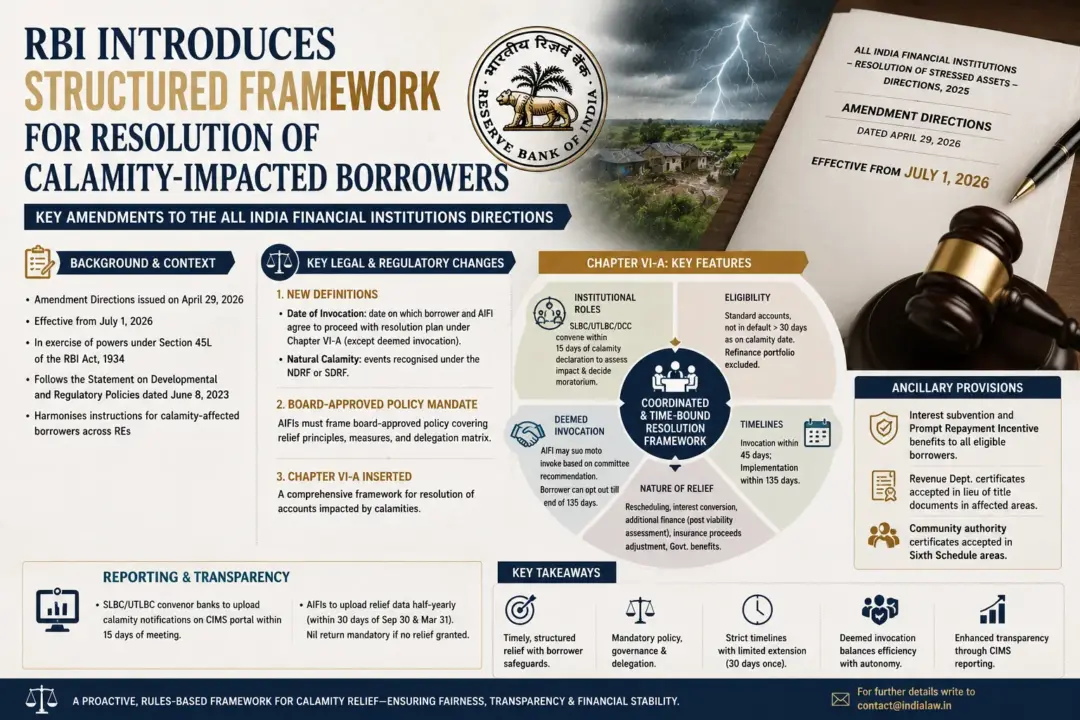
RBI Introduces Structured Framework for Resolution of Calamity-Impacted Borrowers: Key Amendments to the All India Financial Institutions Directions →

Digital Transformation of Bank Guarantees: NeSL’s Integration of Electronic Bank Guarantees with Entity Locker →

FAQs on RBI Circular: Resetting Floating Interest Rates for EMI-Based Personal Loans →

Enforcement of Security Interests Against Educational Institutions: Supreme Court Mandates Strict Compliance Under the SARFAESI Act →