Post-Acquisition Indemnity Failures: What VPS Healthcare’s ₹15.86 Crore Legal Battle Teaches Dealmakers
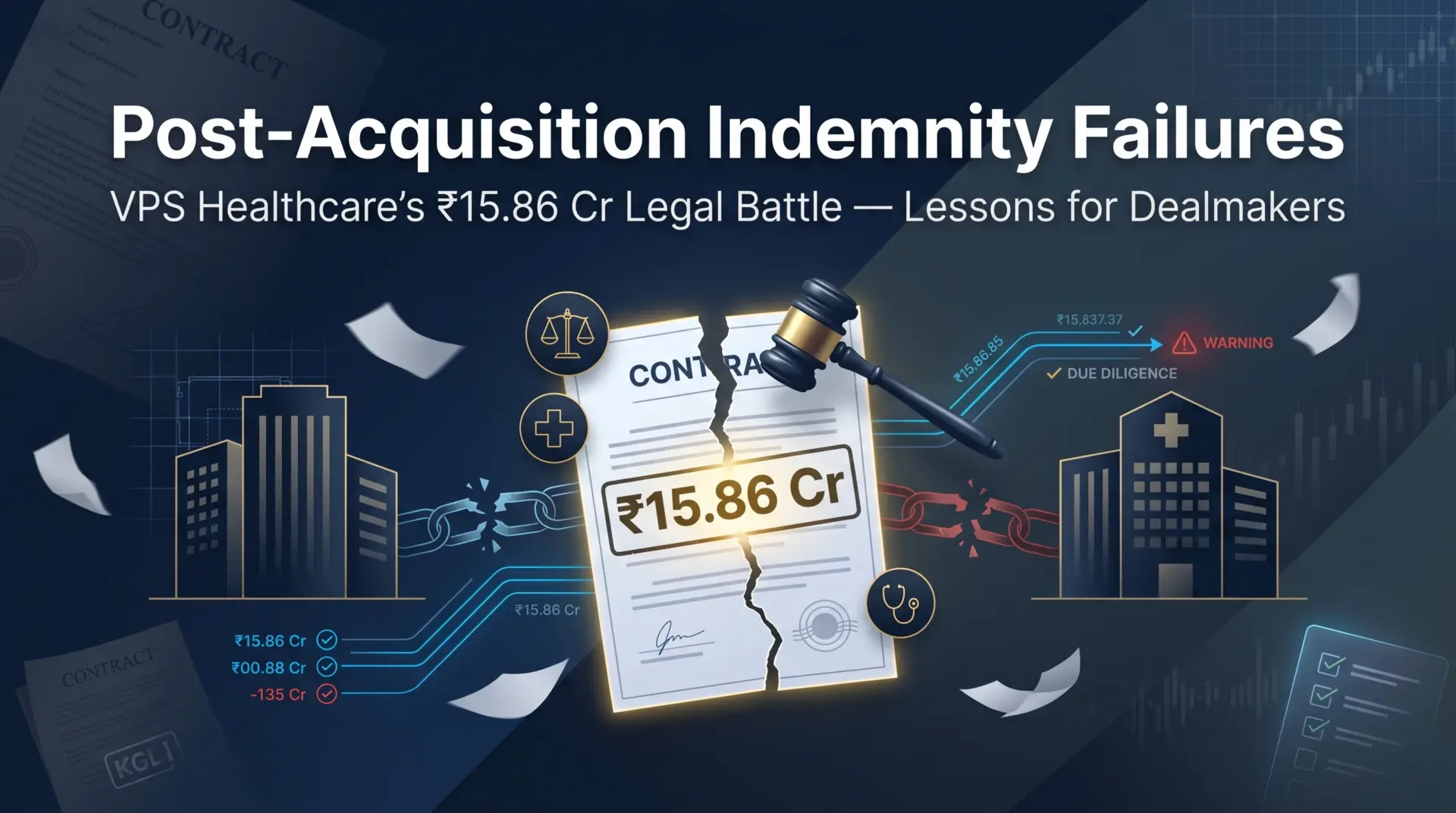
VPS Healthcare’s acquisition of Rockland Hospitals offers a cautionary tale in M&A structuring. A seven-year enforcement battle over a disclosed ₹10 crore EY arbitration claim exposed deep structural weaknesses in the deal’s indemnity architecture. This analysis unpacks the Supreme Court’s ruling in VPS Healthcare v. Prabhat Kumar Srivastava (2026 INSC 361) and the drafting lessons it leaves behind.
Deal Anatomy: How the Acquisition Was Structured
The transaction was a straightforward strategic acquisition: VPS Healthcare, a UAE-backed hospital group, purchasing 100% of Rockland Hospitals Limited from its founding promoters, Prabhat Kumar Srivastava and Rishi Srivastava. The vehicle used was a Share Purchase Agreement (SPA) dated 29 June 2016, through which VPS acquired the entire equity of the target entity, which was subsequently renamed Medeor Hospitals Limited.
At the time of signing, an EY arbitration claim for ₹10 crore (arising from a professional services engagement to find a buyer for the hospitals) was already pending against Rockland. This was a disclosed, quantified liability, exactly the type of item that belongs in the Disclosure Schedule and the indemnity schedule of any well-structured SPA.
The parties resolved this, along with other disputes arising under the SPA, through a Deed of Compromise dated 02.02.2019, subsequently formalised as a SIAC Consent Award on 01.03.2019. The deal structure, from an M&A risk perspective, had three fundamental weaknesses that this case exposes:
- No escrow or retention was established at closing to ring-fence the EY claim.
- Litigation control post-closing was handed to the Promoters via Power of Attorney, without adequate acquirer consent rights.
- The indemnity clause itself contained ambiguous trigger language that invited a seven-year enforcement dispute.
Transaction Timeline
| Date | Event | Significance |
| 11 Aug 2015 | Professional Services Agreement | EY engaged by Rockland Hospitals to find a strategic investor/buyer for two Delhi hospitals. |
| 29 Jun 2016 | Share Purchase Agreement signed | VPS agrees to acquire 100% equity of Rockland Hospitals. Promoters exit the business. |
| 02 Feb 2019 | Deed of Compromise executed | VPS/Medeor and Promoters settle disputes. Promoters agree to take over all Annexure-I litigation, including EY’s ₹10 crore claim. |
| 01 Mar 2019 | SIAC Consent Award | SIAC formalises the Deed of Compromise as a Consent Award in Arbitration No. 093/2017. |
| 17 Aug 2021 | EY wins arbitration award | Majority award grants EY ₹10 crore + 9% p.a. interest against Medeor, plus ₹5 lakh costs. |
| 04 Mar 2022 | High Court stay order | Medeor directed to deposit full award amount (principal + interest) to stay execution. |
| 17 May 2023 | Medeor deposits ₹15.86 crore | VPS/Medeor deposits under protest to prevent sale of assets. Enforcement petition filed. |
| 01 May 2023 | Delhi High Court judgment | High Court defers enforcement of Consent Award, holds Promoters’ obligation arises only after Supreme Court confirmation. |
| 13 Apr 2026 | Supreme Court reversal | 2026 INSC 361: Consent Award enforced. Promoters ordered to pay ₹15.86 crore within 30 days. |
The Indemnity Clause Under the Microscope
The operative indemnity is Paragraph 32(a) of the Consent Award, which incorporated the Deed of Compromise. For M&A practitioners, this clause is a masterclass in what happens when indemnity language tries to do too many things at once: it is part litigation assignment, part cooperation covenant, part absolute guarantee, and part backstop payment mechanism. The Supreme Court decomposed it into five distinct limbs.
| Limb | Obligation | M&A Perspective | Flag |
| 1st | Promoters defend all Annexure-I proceedings at their own cost | A standard seller indemnity obligation, common in SPAs post-closing. The scope is defined by the Annexure, making the disclosure schedule critical. | Drafting Risk |
| 2nd | VPS/Medeor to provide assistance and execute Power of Attorney | Mirrors the “cooperation clause” in most SPAs. Problematic here: it gave Promoters full litigation control post-acquisition, incentivising delay. | Governance Gap |
| 3rd | Promoters may settle or appeal at any stage up to Supreme Court | Broad discretion given to the seller/indemnifier. Acquirers should cap this with a consent right for settlements above a materiality threshold. | Acquirer Risk |
| 4th ★ | “Promoters will ensure no liability is recovered from VPS/Medeor by the Forum” | The absolute, real-time guarantee. This is the clause acquirers need: an ongoing obligation to prevent any recovery, not merely a backstop. The Supreme Court correctly identified this as the operative promise. | Key Protection |
| 5th | If liability confirmed by Highest Court of Appeal, discharge within 30 days | A performance timeline for the extreme scenario. High Court wrongly elevated this to the sole trigger. In M&A terms, this is a “long-stop” backstop, not the primary indemnity mechanism. | Misread Below |
“The fourth limb’s trigger, recovery of liability by a Forum, had fully crystallised by the stay order dated 04.03.2022. This is a present, absolute obligation.” — Supreme Court of India, 2026 INSC 361, para 24
The critical M&A lesson: the 4th limb is the clause acquirers actually need in their SPAs — a real-time, ongoing guarantee that no liability is recovered from the acquiree at any stage of litigation. The 5th limb (30 days after Supreme Court confirmation) is useful only as a backstop for when all else fails.
The two are complementary, not mutually exclusive. The High Court’s error was treating the backstop as the only mechanism.
The Due Diligence and Deal Structuring Failures
Viewed through the lens of M&A best practice, the VPS/Rockland transaction exhibits a pattern familiar to practitioners: the deal closes, the disclosed liability is noted in the documents, the indemnity is agreed and then the structural mechanisms to make that indemnity actually work are absent or underspecified.
No Escrow for Disclosed Claims
The EY arbitration was a known, quantified claim at the time of both the SPA (2016) and the Compromise Deed (2019). Best practice in any acquisition where specific litigation is disclosed is to establish a targeted escrow or holdback at closing, sized to cover the worst-case outcome including interest and costs.
What Should Have Happened: An escrow of approximately ₹15–18 crore should have been established at closing, funded by the Promoters’ sale proceeds, to be released only upon final resolution of the EY claim. This would have made the entire enforcement litigation unnecessary.
Litigation Control Without Consent Rights
The Consent Award gave the Promoters a Special Power of Attorney to defend the EY arbitration. This is commercially sensible; the Promoters knew the history of the EY engagement and could defend it more effectively. However, the arrangement had no governance guardrails:
- No obligation on Promoters to keep VPS/Medeor informed of litigation milestones.
- No consent right for VPS on settlements above a materiality threshold.
- No obligation to settle if the litigation economics clearly favoured resolution.
- No time-bound mandate to resolve rather than indefinitely appeal.
The result was predictable: the Promoters prosecuted the litigation “at leisurely,” as the Supreme Court noted, using VPS’s asset base as collateral while appeals wound through the court system.
Ambiguous Indemnity Trigger Language
The “highest court of appeal” language in the fifth limb created a substantial litigation risk that a more carefully drafted clause would have avoided. In M&A transactions, indemnity obligations should be triggered by a specific, objective, verifiable event. Common triggers used in practice include:
- A formal demand notice from the acquirer upon receipt of an adverse order.
- A court or tribunal order requiring deposit or payment, regardless of whether an appeal is pending.
- Crystallisation of a contingent liability into a definite, quantified sum.
None of these was used here. Instead, the parties used “confirmed by the Highest Court of Appeal”, a trigger that is entirely within the promoters’ control to defer, simply by filing appeals.
Drafting Red Flag: Any indemnity trigger that is within the indemnifier’s own power to delay or prevent is fundamentally defective. The paradox the Supreme Court identified, that the Promoters could avoid liability forever by not appealing to the Supreme Court, should have been caught at the drafting stage.
M&A Risk Matrix: Lessons from This Case
The following matrix maps each structural vulnerability exposed by the case to a concrete risk and a drafting or structuring mitigation:
| Risk Area | Exposure | Mitigation / Best Practice |
| Post-Closing Liability Allocation | Poorly defined indemnity triggers leave acquirer exposed to legacy claims indefinitely during appeal chains. | Specify the exact crystallisation event (court order, deposit, demand notice). Do not rely on “final confirmation” language alone. |
| SPA Representations & Warranties | Seller rep on absence of material litigation may be breached if legacy disputes are not fully disclosed in Annexure/Disclosure Schedule. | Require full litigation schedule; carve out known claims and map each to a specific indemnity obligation with a named indemnifier. |
| Escrow / Retention Structure | No escrow was set up at closing. When EY’s ₹10 crore claim matured, VPS had no ready pool to draw from without enforcement proceedings. | Ring-fence an escrow or retention amount for each disclosed claim at closing. Release only upon claim resolution. |
| Change of Control & Third-Party Claims | EY’s engagement letter was with Rockland. Post-acquisition, Medeor (the renamed entity) bore the liability, a foreseeable change-of-control exposure. | Conduct thorough pre-signing due diligence on all material contracts; renegotiate or novate where change-of-control clauses create acquirer risk. |
| Consent Award Enforcement | Treating a Consent Award as self-executing. The dispute here shows enforcement can be resisted and litigated for years. | Supplement Consent Awards with direct bank guarantees, escrow arrangements, or personal guarantees from promoters/sellers. |
| Integration Period Governance | Promoters retained litigation control via Power of Attorney, incentivising delay rather than swift resolution beneficial to VPS/Medeor. | In SPA, restrict seller’s litigation discretion post-closing; require acquirer’s written consent for settlements above a threshold. |
The Judgment’s Commercial Significance
The “Ensure” Standard
The Supreme Court’s treatment of the word “ensure” as creating an absolute, outcome-based obligation, rather than merely a best-efforts duty, has direct implications for SPA drafting. Acquirers should note that courts will enforce outcome-oriented language at face value. Sellers and their counsel who agree to “ensure” a particular result are taking on a strong obligation.
Conversely, sellers who wish to limit their liability should resist “ensure” language and instead use “use reasonable endeavours” or “take commercially reasonable steps”, which carry a materially lower burden.
Consent Awards as Enforceable Contracts
The Court’s confirmation that a Consent Award is “a contract between the parties with the tribunal’s seal super-added” has practical significance for M&A settlements. When parties resolve acquisition disputes through arbitration consent awards rather than pure contractual amendments:
- The award creates an additional enforcement pathway, both as a contract and as an arbitral award under the Arbitration and Conciliation Act, 1996.
- The executing court’s role is limited: it cannot rewrite agreed terms, and challenges are confined to whether the award has been satisfied, discharged, or is a nullity.
- Parties cannot relitigate the substantive bargain through the guise of “construction” arguments at the enforcement stage.
The Crystallisation Test
For M&A indemnity practitioners, the Court’s “crystallisation” analysis is particularly useful. A contingent liability crystallises, and the indemnity obligation therefore arises, when:
- A court, tribunal, or authority issues an order requiring payment or deposit.
- The quantum becomes definite and quantified.
- The indemnified party actually pays out, or is compelled to set aside funds.
The deposit of ₹15.86 crore by Medeor upon court order was, on this analysis, the crystallisation event, not the ultimate Supreme Court judgment. This is the correct commercial interpretation: an acquirer that has been compelled to park ₹15 crore with a court registrar has suffered a real, present financial burden, regardless of what a future appellate court might ultimately decide.
Model Clause Language: What Better Drafting Looks Like
Based on the structural failures in this case, the following clause language illustrates how a well-drafted post-closing litigation indemnity should address trigger events, control rights, and payment mechanics.
Model: Litigation Indemnity with Real-Time Trigger
“The Indemnifying Parties shall ensure that no Indemnified Liability is recovered from the Acquiree or any Group Company by any Forum. Without limitation to the foregoing, upon the occurrence of a Crystallisation Event, the Indemnifying Parties shall, within 10 Business Days of written demand by the Acquirer, pay to the Acquirer (or as directed) a sum equal to the Crystallised Amount. A ‘Crystallisation Event’ means: (a) any court, tribunal or authority issuing an order requiring the deposit, payment or security of any amount by the Acquiree in respect of an Indemnified Claim; (b) the Acquiree making any payment in respect of an Indemnified Claim; or (c) any settlement of an Indemnified Claim. For the avoidance of doubt, the occurrence of a Crystallisation Event shall not be dependent upon the exhaustion of any appeal process.”
Model: Litigation Control with Consent Rights
“The Indemnifying Parties shall conduct the defence of each Indemnified Claim in good faith and with a view to prompt resolution. The Indemnifying Parties shall: (a) keep the Acquirer reasonably informed of material developments; (b) not settle any Indemnified Claim for an amount exceeding [₹X] without the Acquirer’s prior written consent (not to be unreasonably withheld); and (c) not file any appeal against a final court order without the Acquirer’s prior written consent where the potential liability has already been the subject of a Crystallisation Event. Failure to comply with this clause shall entitle the Acquirer to take over conduct of the relevant proceeding at the Indemnifying Parties’ cost.”
Conclusion
VPS Healthcare’s seven-year journey from acquisition to Supreme Court enforcement ruling is, at its core, a story about structural incompleteness in M&A documentation. The commercial deal, Promoters absorbing the EY liability as part of their exit, was clear. What was not clear was exactly when, and in what circumstances, VPS could compel the Promoters to honour that commitment.
The Supreme Court’s ruling restores the intended commercial outcome: the Promoters bear the liability they agreed to bear, and the acquirer is not left holding the cheque for a pre-closing dispute. But the acquirer had to litigate for years, and deposit ₹15.86 crore, to get there.
“The Promoters are now carrying on the litigation at leisurely, on the shoulders of VPS/Medeor. Such a situation defeats the Consent Award of a commercial dispute.” — Supreme Court of India, 2026 INSC 361, para 13.2
Better deal structuring, an escrow at closing, tighter litigation control provisions, and unambiguous indemnity trigger language, would have made this litigation wholly unnecessary. For M&A practitioners advising on acquisitions with disclosed litigation, this case should be required reading.
For more details, write to us at: contact@indialaw.in
By entering the email address you agree to our Privacy Policy.